The UK’s Hidden Animal Welfare Epidemic
A breeding revolution for our pets has been launched with the release of the Innate Health Assessment (IHA) Tool – a10-Point Checklist for better canine breeding. The IHA Tool, created in partnership with PetProov and the veterinary sector, is based on 15 years of research from the Royal Veterinary College. It is FREE to use via the newly launched IHA website and aims to encourage the breeding of healthier dogs.
For over a century, humans have altered how dogs look to suit trends and our perception of what is cute. Dogs have been deliberately bred to have extreme physical characteristics and, as a result, we have created a huge welfare problem for dogs and an ‘extreme conformation crisis’. Extreme conformations are body shapes that do not exist in nature and carry a high risk of significant health and welfare issues ranging from respiratory issues, painful eye conditions, skin infections, spine and joint issues, neurological defects, blindness, deafness and reduced life expectancy. We have bred dogs with restricted abilities, impaired health and reduced life quality evidenced by veterinary research.
The All-Party Parliamentary Group for Animal Welfare’s (APGAW) ‘Innate Health Assessment’ (IHA) has been created to tackle this issue and to start a breeding revolution leading to physically healthier dogs. Easy and quick to use, it provides a visual checklist of 10 key conformational criteria that are extreme in many dogs, leading to lifetimes of suffering.
This new tool allows every breeder, dog owner or prospective dog owner to reliably check any dog’s innate health characteristics and their suitability to breed and/or acquire. No equipment or veterinary assistance is needed and the IHA Tool guides users step-by-step through each of the 10 criteria, with full instructions on how to assess each one.
For dogs who may have some of the 10 extreme conformations, the IHA can help owners by raising awareness of the difficulties they may face and how to care for them but also how to ensure their future generations have the ability to lead a healthier and longer life. If a dog does not pass the IHA they should not be used for breeding.
Created by the APGAW IHA team, RVC Professor Dan O’Neill, Marisa Heath, APGAW Director and Vanessa Barnes, APGAW Legal Advisor, the IHA is now supported by The UK Centre for Animal Law, Agria Pet Insurance, APDAWG, Battersea, BSAVA, The British Veterinary Association, Blue Cross, Dogs Trust, FOUR PAWS UK, Frontier Economics, GCCF, Hope Rescue, The Kennel Club, LAGECDogs, Naturewatch Foundation, PetPlan, PDSA, RSPCA, The Royal Veterinary College, UFAW and Woodgreen.
Marisa Heath, Director of APGAW stated:
“Breeding of dogs with extreme characteristics is one of the biggest welfare issues affecting our pets and thousands of dogs struggle to perform their basic functions daily owing to this problem. Within the All-Party Parliamentary Group for Animal Welfare, we are determined to address this and to bring the pet sector together to stop bad breeding practice. We hope the Government will support this initiative and show that the UK will be a leading nation on animal welfare and will protect the public from owning pets that live in pain and discomfort.”
Vanessa Barnes, Legal Advisor to APGAW, commented:
“With the launch of the IHA Tool – we hope to educate people to be more responsible, attracting Advocates who can spread the word about the IHA and the need to tackle this growing issue. We are putting the power into the hands of the general public to end the century of suffering caused to dogs by irresponsible extreme conformation breeding practices. The ask is simple – if the dog doesn’t pass The IHA Tool – don’t breed them or buy puppies bred from them. In this way - everyone can play their part in better dog welfare.”
RSPCA
“The RSPCA strongly supports measures that reduce the significant harms caused from breeding with exaggerated physical features. The IHA has the potential to help avoid worst-affected animals being bred from, to prevent future suffering.”
The British Veterinary Association
“The IHA will be a valuable tool to help ensure better selection of animals for breeding and breeder compliance with animal welfare legislation, especially in breeds with extreme conformation. It complements tests for genetic traits, such as the BVA and Kennel Club Canine Health Schemes.”
Professor Dan O’Neill, Royal Veterinary College
“Dogs are much loved members of our families but sadly many suffer shortened and miserable lives due to severe health and welfare problems linked to their extreme body shape. APGAW’s IHA tool helps breeders to avoid breeding from animals who have poor innate health and therefore acts to reduce the suffering of future generations of dogs caused by having extreme body shapes.”
Visit www.innatehealthassessment.org to try the tool on your dog and read more about the work. #BreedingRevolution #IHA
Further commentary is available on request from the wider team including Professor Sandy Trees and Dr Neil Hudson MP who co-chair the APGAW.
Contact marisa@apgaw.org or info@apgaw.org for more information on the IHA
IHA points of clarity:
- We believe that dogs have a right to move freely, breathe normally, blink, sleep soundly, scratch themselves and communicate.
- The IHA Tool is not specific to breeds – it’s about the health and welfare of individual dogs.
- The IHA aims to educate and equip people to make better choices. It does not exist to criticise existing pets which may have extreme features. Instead, we want to help owners care for that dog and consider a different choice in the future.
- It is against the law for commercial breeders to produce puppies or get a bitch pregnant if there is a reasonable chance that the bitch or puppies are likely to suffer from health or welfare issues.
- Conformational health does not equal complete health – check your breeds health tests.
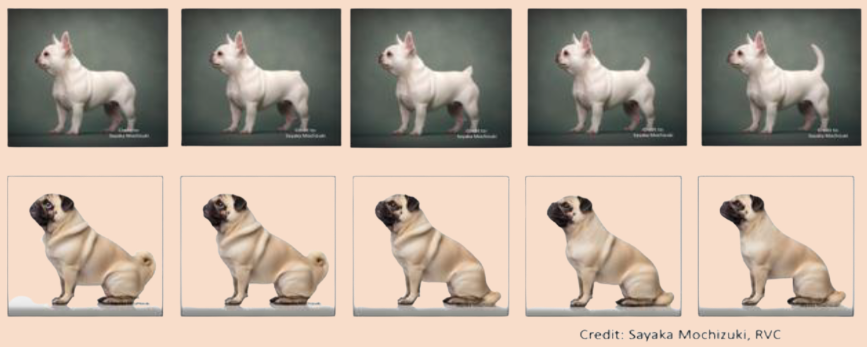
- The APGAW IHA aim is not to ban breeds (a step other countries are taking) but to protect them. It offers a route for breeds linked with dogs showing extreme conformations to move towards moderate and legally compliant conformations. The below AI images show the potential to move a breed showing extreme traits towards a version of that breed without those extreme features. If all breeders adopted the IHA and agreed to breed only from dogs passing it, a more moderate conformation in terms of future generations of puppies would only take two or three breeding cycles for a tangible difference to be seen.
Previous article